


Introduction
Butlers is a beloved German lifestyle and home décor brand, known for its carefully curated collections of interior accessories, kitchenware, and seasonal decorations. Butlers made a strategic decision to re-establish its own direct-to-consumer online store — this time on Shopify.
Having operated an online store before, the team knew from experience that page speed is not a nice-to-have: it is one of the most direct levers for conversion. So rather than treating performance as a problem to fix later, Butlers took a different approach — they built on speed from the very start, integrating Speed Kit during the launch of the new store itself.
The integration was completed within one week, making this one of the first times Speed Kit was deployed as a foundational performance layer from day one — not as a fix, but as a deliberate head start.
"We knew from our previous e-commerce experience that page speed directly impacts conversion. When we decided to launch our own store again, building on a fast foundation from day one was a clear priority for us — not an afterthought. Speed Kit was live within a week, and the results speak for themselves."
Challenge
Re-launching a direct-to-consumer store after a period on a third-party marketplace comes with high expectations — from customers and from the business alike. Butlers knew that first impressions matter, and that a slow storefront on launch day is not just a technical issue: it is a brand issue.
From prior e-commerce experience, the team understood that loading times have a measurable, direct impact on conversion rates. Slow pages cost orders. Rather than waiting to see how the new Shopify store performed and optimizing reactively, Butlers set a clear goal: launch fast, stay fast.
The challenge was to reach a state-of-the-art performance baseline from the very first day the store went live — with no runway for a prolonged optimization phase.
Solution
Butlers integrated Speed Kit into their new Shopify store during the launch itself. The full integration was completed within one week, ensuring that Speed Kit's caching and acceleration layer was active from the moment the store opened to customers.
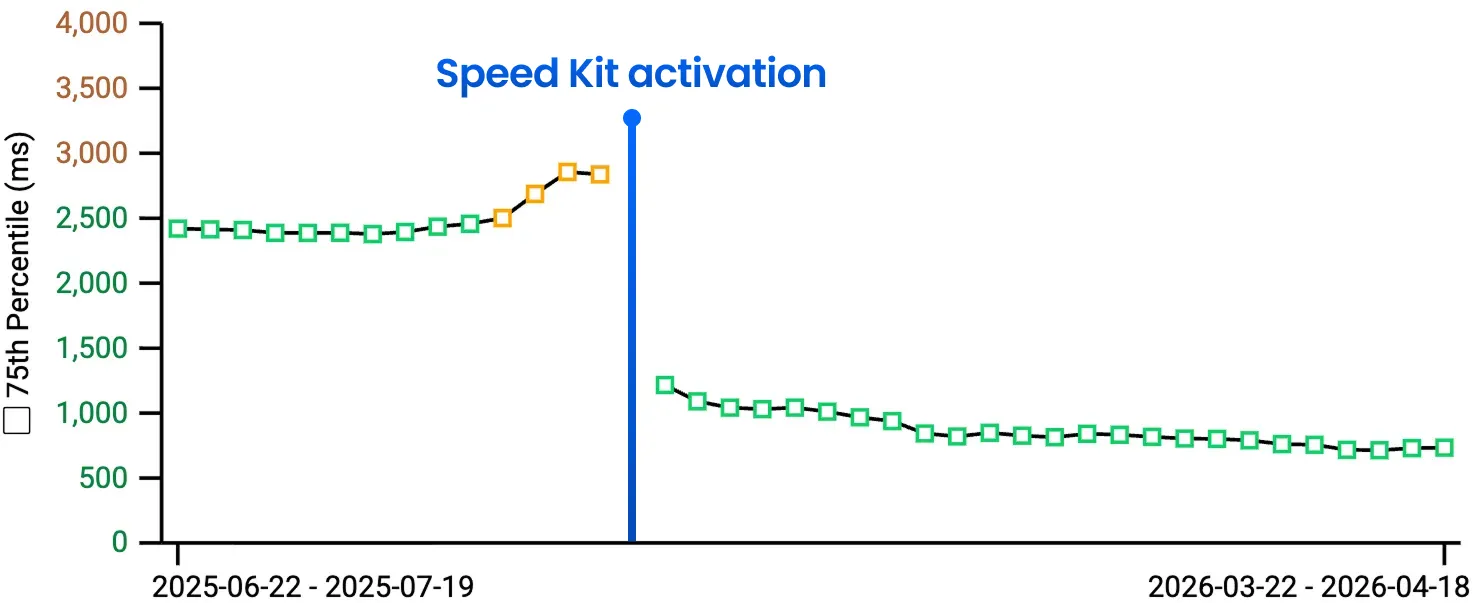
Speed Kit accelerated the store's Largest Contentful Paint by 416 ms through its intelligent caching technology, which serves even dynamic, personalized pages at CDN-like speed — without requiring any changes to the underlying Shopify setup. The result was a seamless, high-performance experience available to every visitor from day one.
Speed Kit is an official ACE eligible technology partner and independent software vendor (advanced tier) of the AWS Competency Partner Program "Accelerate" as well as the Workload Migration Program. Our technology is powered by 13 different AWS services:
- Elastic Kubernetes Service (EKS): We use EKS to schedule and orchestrate our Speed Kit applications on EC2 instances.
- Simple Storage Service (S3): Speed Kit stores cached assets in S3 buckets. Additionally, we store RUM (Real User Monitoring) and PI (Performance Insights) data in S3 buckets for analytics purposes.
- Elastic Compute Cloud (EC2): Our workloads are hosted on EC2 instances, as managed through EKS.
- Kinesis Data Streams: Kinesis Data Streams are used to ingest RUM and PI data from Speed Kit, which is then consumed by Amazon Managed Service for Apache Flink. Fastly also streams access logs to our Kinesis Data Stream, which are similarly consumed by Amazon Managed Service for Apache Flink.
- Athena: We use Amazon Athena to query data stored in AWS S3 buckets, enabling performance insights and asset preloading.
- Elastic Container Registry (ECR): Docker images are stored in ECR and deployed in our Kubernetes cluster, which is managed by EKS. For third-party application images, we use the pull-through-cache feature of ECR.
- Elastic Container Service (ECS): We build Docker images using a service hosted on Amazon ECS.
- Route 53: Route53 is used to manage DNS records.
- Simple Email Service (SES): We use SES is used for sending transactional emails.
- Managed Streaming for Apache Kafka (MSK): We use MSK to facilitate consuming and producing custom event records for different applications.
- DynamoDB: Speed Kit uses DynamoDB to store information related to our predictive preload feature.
- Lambda: We use Lambda to pre-render client side renderd pages to make that actual server side rendered.
- ElastiCache (Redis OSS): We use ElastiCache to store our Bloom filter, which checks whether an asset is present in our cache.
-min.webp)
Click the image to open the architectual diagram of Speed Kit with AWS
Results
The impact of launching with Speed Kit built in was immediate and measurable. An A/B test conducted at launch confirmed the performance and business results:
- 416 ms faster Largest Contentful Paint — bringing the store to a 714 ms LCP, placing it firmly in the top tier of e-commerce performance.
- 96% of pages scoring green on Core Web Vitals for LCP — a state-of-the-art result that reflects the consistency of the acceleration, not just peak performance.
- +9.07% conversion rate uplift — a direct commercial result of the faster experience, measured against the unaccelerated control group.
Largest Contentful Paint
Conclusion
For Butlers, the decision to integrate Speed Kit at launch rather than after the fact meant there was no period of lost conversions, no remediation project, and no compromised first impression. Speed was part of the product from the start.

