Speed Kit 2025: The Shift From Optimization to Prediction

For the last decade, web performance has been a game of marginal gains. Developers have fought for every millisecond, optimizing distinct requests and shaving bytes off payloads. But in 2025, we hit a realization that changed our trajectory: optimization has a ceiling. To truly eliminate loading times and achieve our vision of an instant web, we had to stop reacting to user interactions and start predicting them.
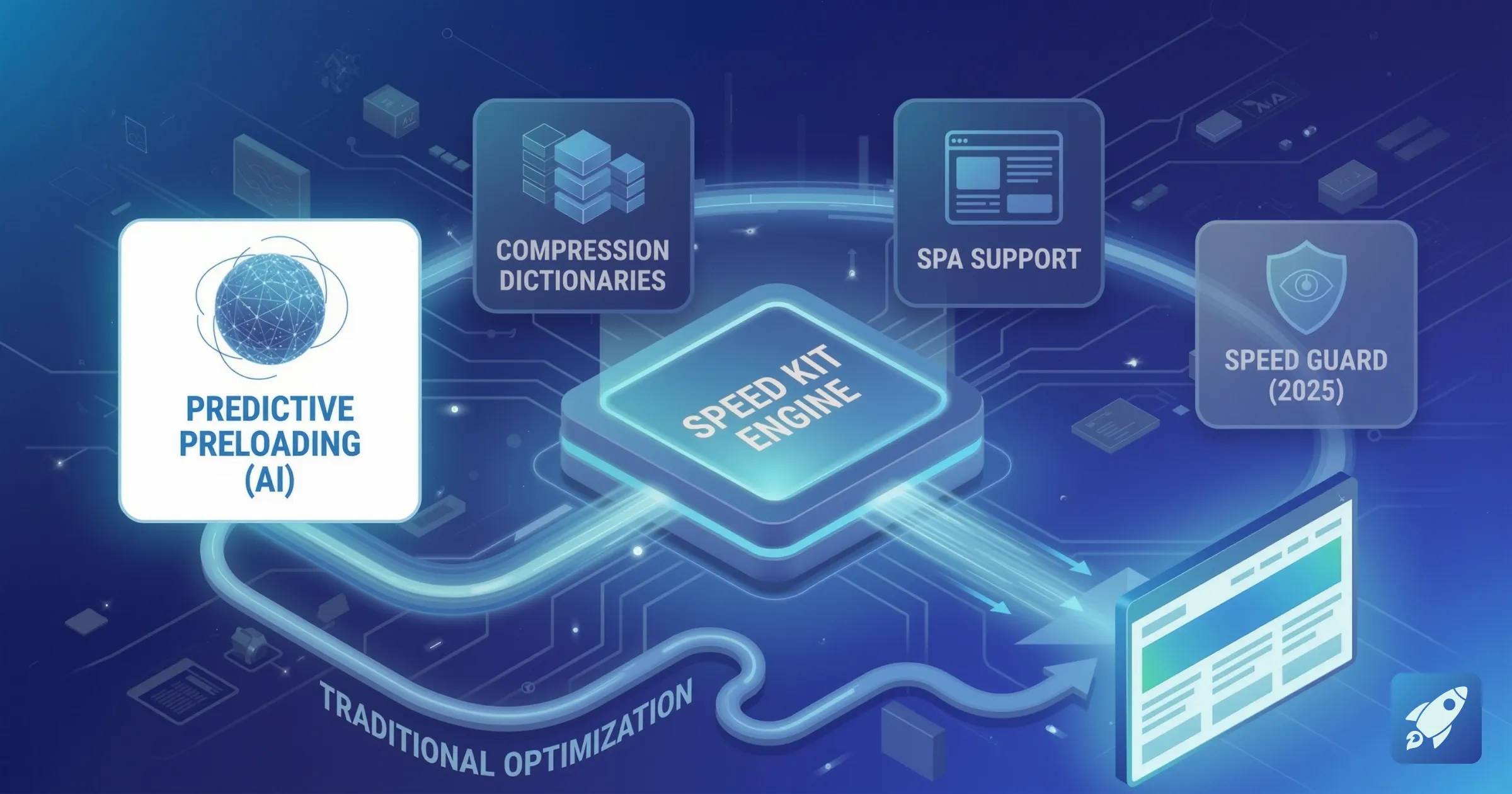
This year marked our transition from standard optimization to prediction. By combining machine learning with cutting-edge browser standards, we made "instant" technically achievable. Here is a look at the engineering breakthroughs, data initiatives, and platform evolutions that defined Speed Kit in 2025.
The End of Latency: Predictive Preloading
The centerpiece of our 2025 roadmap was the rollout of Predictive Preloading, a feature that fundamentally changes how pages are delivered. But to understand this breakthrough, one must look at the foundation it is built upon: our unique Dynamic Caching technology.
While standard HTML is often uncacheable due to personalization, Speed Kit has always solved this by decoupling the static frame from the dynamic content. We cache a "neutral," anonymous shell that loads instantly, while personalized elements merge in client-side.
This established architecture became the critical unlock for our 2025 prediction engine. Because we have a safe, cacheable version of every page ready on our infrastructure, we can aggressively pre-load content without risking security or overloading your origin.
Our solution is unique in the market because it solves the four biggest challenges of predictive navigation simultaneously:
- Zero Origin Load: We only prefetch the anonymous HTML from the Speed Kit infrastructure. This ensures that aggressive preloading never adds load to your origin servers or database.
- No Side-Effects: We manage the client-side execution environment to ensure JavaScript only executes when a page actually becomes visible. This safeguards the browser's main thread to ensure the current user experience remains smooth, while simultaneously preventing skewed analytics and data corruption.
- Bandwidth Efficiency: By leveraging Compression Dictionaries, we drastically reduce file sizes to minimize client-side bandwidth costs. This efficiency makes it feasible to pre-load multiple potential user paths without bloating data usage.
- Hyper-Accuracy: We do not rely on simple heuristics. Our predictions are driven by AI models trained on your specific Real User Monitoring (RUM) data, achieving an accuracy rate higher than 85%. This allows us to accurately anticipate user intent and pre-render the right page at the right time.
By combining this sophisticated caching layer with speculation rules, we achieve Largest Contentful Paint (LCP) times under 300ms, delivering an experience that feels instantaneous.
Enabling Compression Dictionaries at Scale
Aggressive preloading presents a significant challenge: bandwidth usage. To make predictive preloading viable at scale without inflating data costs, we became one of the first companies to deploy Compression Dictionaries in production.
This technology goes beyond standard compression by building a custom dictionary for each application. By analyzing RUM data, we identify the most frequently used HTML resources and learn the structural patterns unique to your specific shop. This allows us to find the right balance between dictionary size and compression rate.
The results are substantial: we are seeing an average file size reduction of 79% compared to standard gzip compression, with some files achieving compression rates as high as 95%. This efficiency is the key enabler of our prediction strategy, allowing us to preload multiple potential user paths for the bandwidth cost of a single traditional page load.
Revolutionizing Single-Page Applications (SPAs)
2025 was also the year we closed the performance gap for Single-Page Applications (SPAs). While SPAs offer fluid interfaces, they have historically faced distinct challenges: Client-Side Rendering often delays the visual start, and the native Speculation Rules API does not support soft navigations. Most critically, they suffer from a measurement blind spot where Google's CrUX report captures only the initial load, effectively ignoring subsequent views and putting SPAs at a distinct SEO disadvantage.
Server-Side Rendering (SSR) for Client-Side Apps
We introduced a robust solution for the "blank screen" problem inherent in Client-Side Rendering (CSR). Crucially, our approach is platform-agnostic, meaning it works with all common frameworks—even those that do not support SSR natively.
Once the Speed Kit Service Worker is installed, we replace the empty initial shell with a cached, Server-Side Rendered (SSR) version of the HTML. To do this without interfering with your application logic, we utilize a cutting-edge web standard: Declarative Shadow DOM.
This technology allows us to render the visual content entirely without Client-Side JavaScript. This drastically optimizes the Largest Contentful Paint (LCP), while ensuring that your JavaScript framework initializes safely in the background—unaffected by the pre-rendered content and without hydration conflicts.
Fixing the Measurement Blind Spot
We tackled the industry-wide challenge of measuring "soft navigations" (views that load without a full page refresh). This required a fundamental evolution of our Real User Monitoring (RUM) data pipeline.
Unlike a "hard" navigation, a soft navigation does not have a clean cut-off point. A user action can trigger a new view at any moment, often while data for the previous view is still being processed. To solve this, we built a system capable of logically reassigning tracked data from the old view to the new soft navigation, ensuring accurate attribution even in complex SPA environments.
Furthermore, standard metrics were not designed for these transitions. We actively participated in Chrome Origin Trials to test new standards like Interactive Contentful Paint (ICP). While waiting for the final implementation to land in Chromium, we developed our own proprietary heuristic to measure image rendering during soft navigations immediately, giving you visibility where standard tools are still blind.
Soft-to-Hard Navigation: Enabling Prediction for SPAs
Standard SPAs rely on "soft navigations" (JavaScript routing) to move between views. While fluid, this architecture often limits the browser's ability to perform aggressive optimizations. This year, we rolled out our Soft-to-Hard navigation technology, which intelligently converts these subsequent soft navigations into standard hard navigations.
Crucially, this is not a blanket rule. We apply this conversion conditionally: only when the target page has been successfully prefetched and our algorithms determine that loading the pre-rendered page from the cache is strictly faster than the native soft navigation would be.
The main driver for this intelligent switching is unlocking prediction. By converting to a hard navigation, we can leverage the browser's native Speculation Rules API to pre-render the next view in the background. This bridges the gap between SPAs and modern browser standards, bringing instant, sub-300ms navigations to the Single-Page Application world.
Strengthening the Platform Foundation
Our shift to prediction was supported by major infrastructure and ecosystem investments:
- Infrastructure Evolution: We completed a full migration of our app cluster from Docker Swarm to Kubernetes. This shift allows us to scale individual components of our backend system with much greater granularity, resulting in significantly higher efficiency and optimized resource usage across our infrastructure.
- Documentation, Video & AI Support: We released a comprehensive overhaul of our Product Documentation and a new Product Video. These resources provide deep dives into complex topics like dynamic caching and our prediction algorithms. To make this knowledge instantly accessible, we integrated a RAG-based AI Assistant (an AI system that retrieves information from a knowledge base, like the documentation, to generate grounded and accurate responses) into our documentation hub. This tool answers your specific technical questions in real-time, acting as an always-on expert for your development team.
Decision Support: The Migration Advisory Service
One of the biggest risks in e-commerce is migrating to a new platform based on promises of "native performance" that fail to materialize in the real world. To protect your business from this common pitfall, we leveraged our internal data to launch the Migration Advisory Service.
This exclusive service for our customers utilizes our proprietary Shop System Comparison Database, which aggregates Real User Monitoring (CrUX) data from over 20,000 e-commerce shops. This allows us to provide you with transparent, data-backed benchmarks of how target platforms actually perform in the wild — cutting through the marketing fluff.
Beyond raw data, we now facilitate peer-to-peer connections, introducing you to other Speed Kit customers who are already running on your target architecture. We encourage you to involve us early in your migration planning. By doing so, we can help you validate your architectural choices with real-world evidence, ensuring your next move is a step forward, not a step back.
More Than a Tool: A Performance Partner
Despite these massive engineering leaps, from AI-driven predictions to solving the SPA performance gap, we made a conscious decision: we did not raise our prices.
We did this because we view our relationship with you as a partnership, not a transaction. We are driven by a genuine passion for the open web. Our team is internationally recognized as being at the top of the field, constantly pushing the boundaries of what is technically possible.
Crucially, Speed Kit is not just a tool. We are a team. We actively share our deep expertise with your developers, helping you navigate the complexities of web performance. Our goal is to ensure you always get the best results, backed by a partner that cares about your speed as much as you do.
Leading the Industry: Standards, Research & Community
With Speed Kit, you always benefit from what is technically possible. We pride ourselves on being the first to implement new web standards, such as Speculation Rules and Compression Dictionaries, ensuring you benefit from the latest speed uplifts before they become mainstream.
To achieve this, we work closely with browser vendors and the international web performance community, providing feedback that helps make these new implementations more robust for everyone. A highlight of this commitment was our participation in the perfnow conference in Amsterdam this year. As the most important international gathering for the web performance community, we were proud to attend with a team of six experts. This deep engagement allows us to stay ahead of the curve and directly influence the future of the web performance ecosystem.
This innovation is deeply rooted in our DNA. Speed Kit was founded on university research, and we maintain a strong connection to the academic world. We actively shape the future of computer science by supervising Bachelor, Master, and PhD theses, ensuring that our technology remains grounded in rigorous scientific analysis.
Beyond research, we are committed to teaching the next generation of developers. Our team includes two Google Developer Experts (GDEs) who have traveled the globe this year to share their knowledge. They delivered more than 15 talks at Google DevFests and other major tech conferences across three continents, helping to educate the wider community and advocating for a faster, more efficient web.
Global Expansion: Japan
This year marked our strategic entry into Japan, made possible through a strong partnership with Gaprise. This expansion is particularly exciting because the Japanese web landscape presents a perfect use case for Speed Kit.
We have observed that websites in Japan are often significantly "heavier" than the global average, featuring richer media and more complex structures. Consequently, our system provides an even greater benefit here. By deploying our predictive preloading and advanced compression in this environment, we are seeing outsized performance gains, effectively neutralizing the latency usually caused by these heavy payloads.
Looking Ahead to 2026: Speed Guard
While 2025 was about eliminating latency, next year is about eliminating uncertainty.
This shift is driven by a major industry milestone: Largest Contentful Paint (LCP) and Interaction to Next Paint (INP) have officially achieved "Baseline Newly Available" status. With these metrics now standardized across all major browser engines, the definition of "fast" is no longer up for debate. It is a universal requirement for every user on every device.
But hitting these targets once is not enough. Maintaining performance is often harder than achieving it. Code deployments, third-party scripts, and content changes can silently degrade your site speed over time.
To solve this, we have built the foundation for our main goal of 2026: Speed Guard.
Speed Guard is designed to solve the stability challenge by making the deep expertise of our performance engineers available at scale. By combining our granular Real User Monitoring (RUM) data with Agentic AI, we are effectively codifying our team's knowledge into an autonomous system.
Speed Guard won't just tell you that you have a problem—it will tell you how to fix it. This empowers your developers with actionable, expert-level advice in real-time, ensuring that the speed you gain is the speed you keep.